Memoirs Of Lieutenant-General Sir Thomas Picton, Vol. II by H. B. Robinson
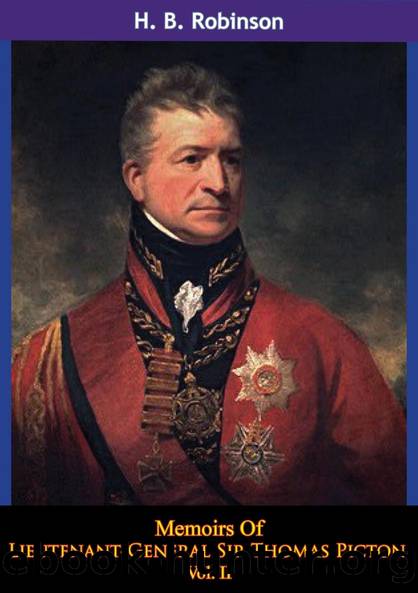
Author:H. B. Robinson [Robinson, H. B.]
Language: eng
Format: epub
Tags: History, Military, Napoleonic Wars, Europe, France, Spain & Portugal, Great Britain, General
ISBN: 9781786259882
Google: r4_EDAAAQBAJ
Publisher: Pickle Partners Publishing
Published: 2016-07-26T03:01:18+00:00
CHAPTER X.
The British army crosses the Bidassoa.âSurrender of Pamplona.âInvasion of France by the British army.âAddress of Wellington to his soldiers.âDefeat and retreat of the French army.âAdvance of the Allies to Bayonne.âThe French again defeated.âEffective state of the Third Division when rejoined by Sir Thomas Picton.âHis account of the prospects of the Allied army.âLord Wellingtonâs operations against Bayonne.âAdvance of the Allies into the interior of France.
DURING Sir Thomas Pictonâs absence in England, his division had been gaining additional laurels under Major-General Colville. It was determined by Lord Wellington to force the passage of the Bidassoa early in October; as, by securing this advanced position, the whole of his line could pour into France at the same moment, so soon as the reduction of Pamplona left him at liberty to enter the enemyâs country. Before this fortress was in his possession, it was impossible to commence any grand scale of offensive operations: but during this interval every preparation was made for the projected invasion. The enemy occupied a remarkably strong post on the French side of the Bidassoa.
On the 7th of October, at three o'clock in the morning, the whole of the troops destined for this service were in motion, amidst a heavy thunder-storm. Every precaution had been taken to prevent the enemy from being made acquainted with this movement; and this was effected with so much success, that the allied force, which was formed into three columns, and crossed at three different fords, was not discovered until the heads of the leading regiments were half over the river. A brisk fire was then opened by the French upon the advancing columns: the water was soon stained with their blood, and all who fell there died. But they were quickly revenged: the light troops pushed rapidly forward, gained the opposite bank, and drove the enemy from their position. This done, as the British columns reached the bank, they quickly formed, and prepared to attack the French line, which was being drawn up on the nearest range of hills.
Notwithstanding the imposing nature of the ground and its natural defensive strength, only a trifling resistance was made in comparison with what the British general had anticipated. The troops drove the enemy from each height in succession, until the French left the conquerors in undisputed possession of the field. Soult now concentrated his army behind a strongly fortified position on the Nivelle, which he had for some time been preparing; and here he resolved to make another stand against the march of his pursuers.
The point occupied by the right of the allied army, (to which the âfighting divisionâ was at this time attached,) enabled it at once to pour down into the plains of France whenever the moment appeared favourable. The left of the army was now placed in an equally favourable situation, and nothing therefore remained to delay this movement but the reduction of Pamplona.
On the 1st of November, the Marquis of Wellington received a despatch from the commander of the Spanish forces employed
Download
This site does not store any files on its server. We only index and link to content provided by other sites. Please contact the content providers to delete copyright contents if any and email us, we'll remove relevant links or contents immediately.
Fanny Burney by Claire Harman(26603)
Empire of the Sikhs by Patwant Singh(23086)
Out of India by Michael Foss(16853)
Leonardo da Vinci by Walter Isaacson(13337)
Small Great Things by Jodi Picoult(7143)
The Six Wives Of Henry VIII (WOMEN IN HISTORY) by Fraser Antonia(5515)
The Wind in My Hair by Masih Alinejad(5095)
A Higher Loyalty: Truth, Lies, and Leadership by James Comey(4964)
The Crown by Robert Lacey(4817)
The Lonely City by Olivia Laing(4802)
Millionaire: The Philanderer, Gambler, and Duelist Who Invented Modern Finance by Janet Gleeson(4478)
The Iron Duke by The Iron Duke(4356)
Papillon (English) by Henri Charrière(4274)
Sticky Fingers by Joe Hagan(4199)
Joan of Arc by Mary Gordon(4113)
Alive: The Story of the Andes Survivors by Piers Paul Read(4033)
Stalin by Stephen Kotkin(3969)
Aleister Crowley: The Biography by Tobias Churton(3640)
Ants Among Elephants by Sujatha Gidla(3467)
